|
|
 |
gNa+
Design Architecture+Design at the boundaries of logic+poetry / sensation+imagination Gerard Nadeau, AIA, LEED AP e.: gerard @ gnaplus.netp.: 617.501.9618
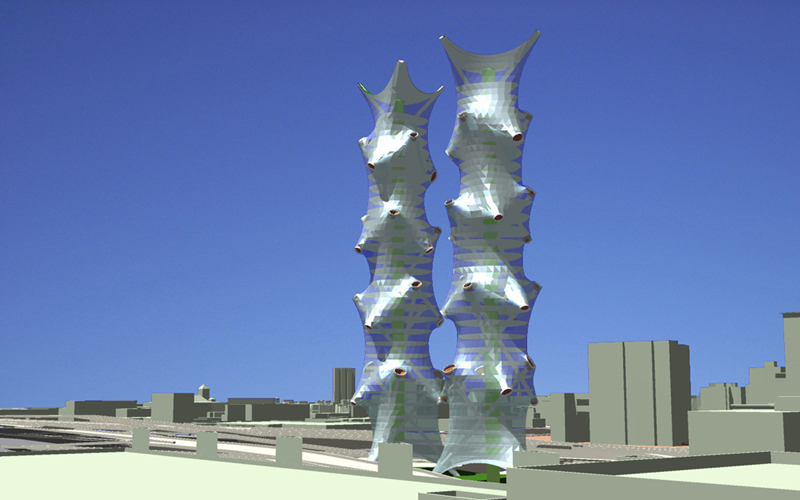
Tensegrity Tube Towers, Boston, MA. gNa+Design is a comprehensive,
research-based design practice embracing public art, residential, commercial and retail construction. Focused on the role
of design and construction in enhancing meaning in our lives, we believe that sensitivity and innovation are our most important
assets. Fully engaged with issues of contemporary life, we listen carefully to our clients, and bring value to their projects
through an inquisitive and synthetic approach to program, site and construction that re-imagines possibilities in service
to client needs and aspirations.
|
|
|
17 Jul 14
Membrane Tensegrity
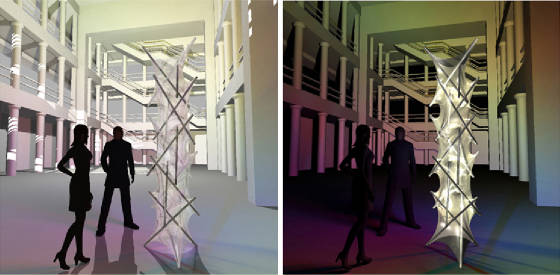 The proposed
Fantastic Elastic Thermo-Plastic Tensegrity Tube Tower (FETP3). The proposed
Fantastic Elastic Thermo-Plastic Tensegrity Tube Tower (FETP3).
Work with membrane tensegrity structures, specifically with elongated tube structures,
has been ongoing for quite some time, but the recent development of a fully parametric model in Rhino+Grasshopper will lead
to the fabrication of large scale protorypes soon. We'll keep you posted! 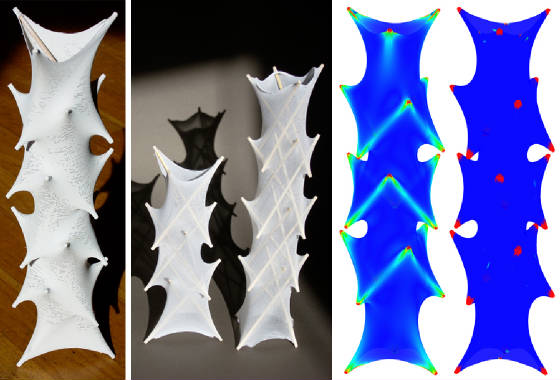 Small
scale stretch fabric models demonstrating structural feasibility + mean curvature (blue indicates a mean curvature approaching
zero) and Gaussian curvature (blue indicates -.001 to -35) analyses of a computationally derived membrane. Small
scale stretch fabric models demonstrating structural feasibility + mean curvature (blue indicates a mean curvature approaching
zero) and Gaussian curvature (blue indicates -.001 to -35) analyses of a computationally derived membrane.
In a membrane tensegrity system, a structural
membrane replaces the tendons utilized in a typical tensegrity structure. The in-plane tensile forces of the membrane are
in equilibrium with the axial forces of the compression struts, and the two discreet sets of elements support eachother. I
have developed a multi-tiered tube system, using 3 to 5 compression struts per tier (as physical models, for the most part)
inside a continuous sheath to create vertical structures. 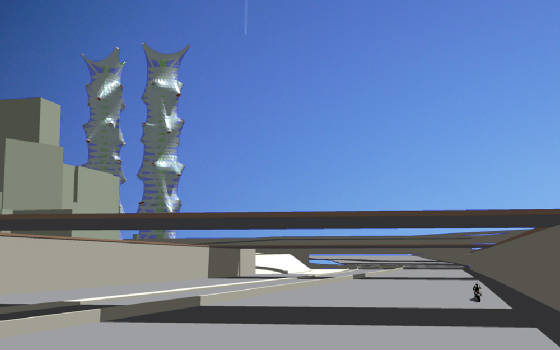 Tensegrity
tube towers from Boston's I-90.
9 Feb 13
Morning Song/Evening Song
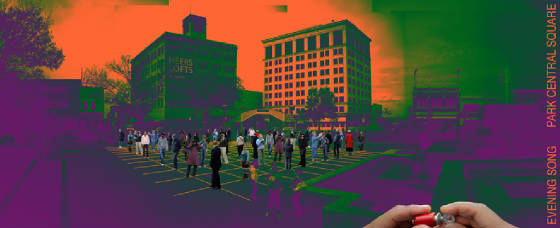 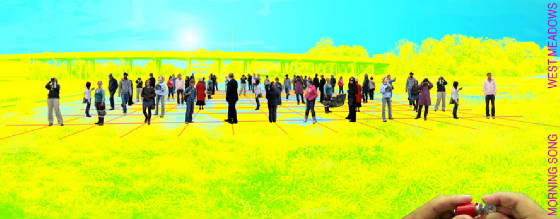
Morning Song/Evening Song gathers 288 Springfield residents in a gesture
of rejuvenation, creating a cacophony of bird-like song to celebrate the dawn at a brownfield site scheduled to become an
urban park, and to celebrate the night at the recently renovated Park Central Square in the center of downtown, two sites
half a mile apart in Center City. 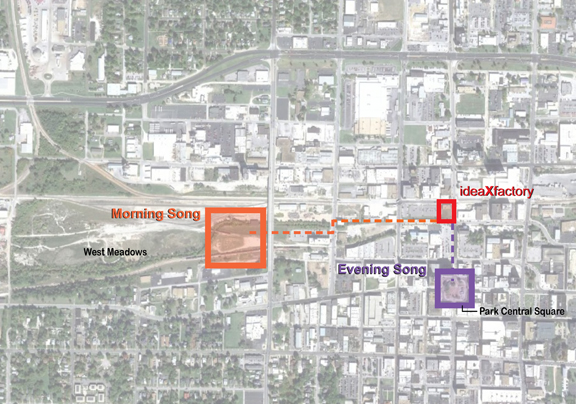
Morning Song/Evening Song comprises two separate
events, each event a gathering of 144 Springfield, MO, residents of all ages, each person or child in possession of an Audubon
Bird Call, a simple birch wood and metal instrument operated by twisting a zinc plug inside a turned wood dowel. The first
gathering will occur in the morning at dawn on a brown-field site in the Springfield Center City that is the proposed location
of West Meadows Park, still several years away. The second gathering will occur at dusk in Park Central Square in the heart
of downtown Springfield several blocks away, as an event during that month’s First Friday Art Walk. In each instance
the participants will arrange themselves in a loose grid with everyone standing about 6 feet apart in each direction, over
an area approximately 576 square yards (about a third of a football field). Once in place, the participants will begin making
bird calls in sequence, with each participant calling over a very carefully determined duration of time. The work will begin
silence, broken at first by one individual song, increasing as a scattered music of call and response with the sound growing
over the course of about 15 minutes into a crescendo of bird calls before fading into a single voice with a return to silence.
The morning event will coincide with the rising of the sun, and the potential of framing the dawn with the Grant Ave. overpass
as a backdrop. The evening event will coincide with sunset, with the light hopefully catching the tops of the taller buildings
on the square as the Square itself fades into shadow. The bird-song component of each event will last 30 minutes. A videographer recorded each event. Participants kept their bird calls.
The installation occured April 4 & 5, 2014. 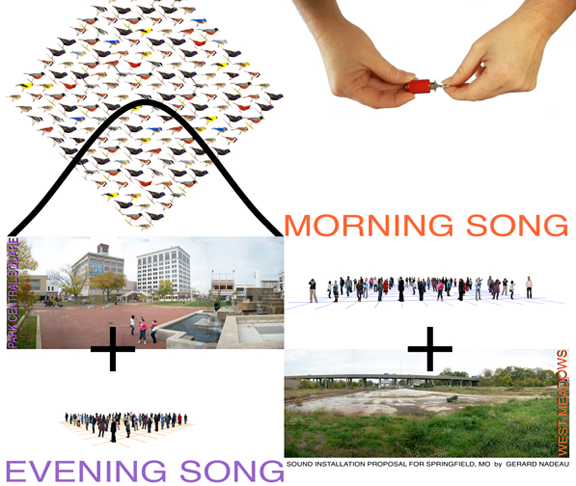
19 Sep 10
Diurnal Piers
gNa+
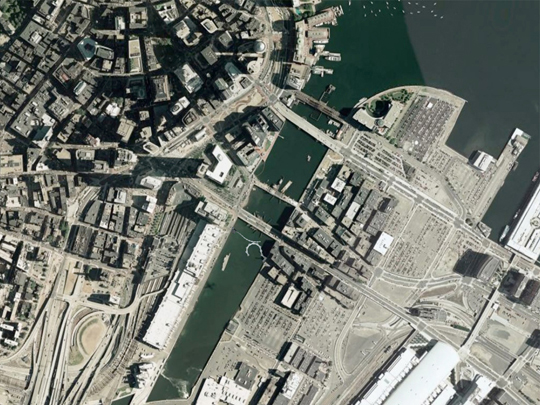
proposes access to the water sheet and a new form of conveyance across Fort Point Channel to the south of Summer Street
as a variation of the Channel's celebrated mechanical bridges. 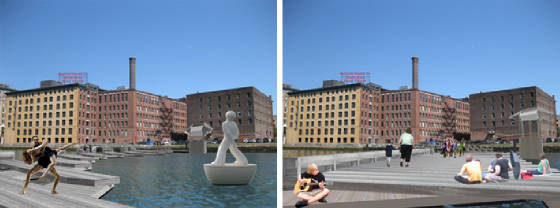
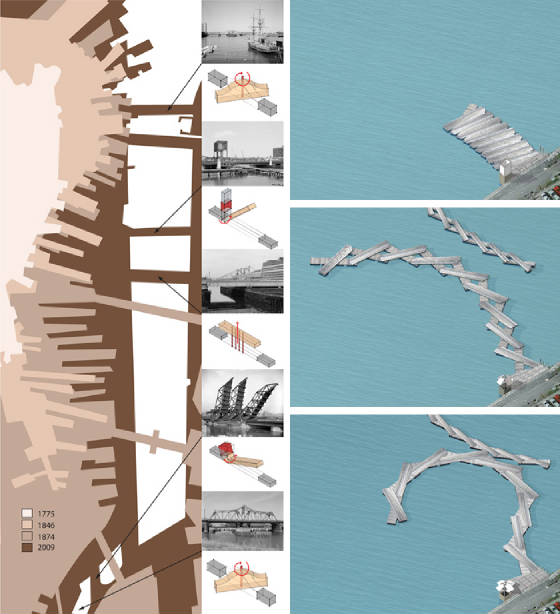 Diagram showing the changing Boston shoreline and movable Channel bridges. Illustrations
of Piers deploying. Diagram showing the changing Boston shoreline and movable Channel bridges. Illustrations
of Piers deploying.
Our proposal acknowledges the incredible importance of Boston's seafaring past by alluding to both the piers that
bristled from the city's shores, and to the unique bridges that opened and closed as cargo vessels shipped with the tides.
The Fort Point Channel bridges are a national engineering treasure, represent an incredibly diverse and imaginative negotiation
of conveyances on land and water, the mechanisms of turning gears, wheels, and counterweights echoing the Newtonian clockwork
of the solar system, the diurnal rotations of the earth and moon that gives us the cycles of the tides, syncopated with day
and night, work and play. The piers extend out into the water as a celebration of voyage and crossing, the reach of imagination,
a freight of ideas, and the possibility of reconciling technological aspirations with an experience of the natural environment. 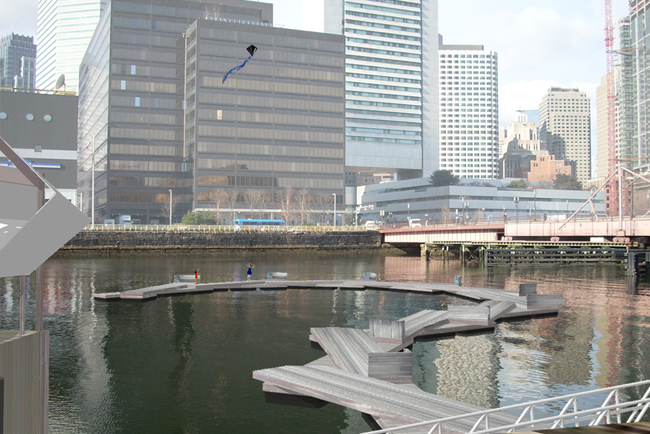
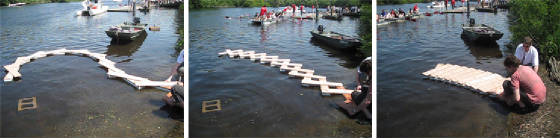 Deployment
of 1"=1'-0" prototype in the Charles River. Deployment
of 1"=1'-0" prototype in the Charles River.
Special thanks to Elsiana Zhaka, Beth Baniszewski, Michael Kyes, David
Porter, David Rubino, and James Vayo.
|

|
|
2014.07.01 |
2013.02.01 |
2010.09.01

|
architecture + design
|
|
|
|
|
|
|
Featured
Project
|
|
|
|
|
|
|
|
|
|